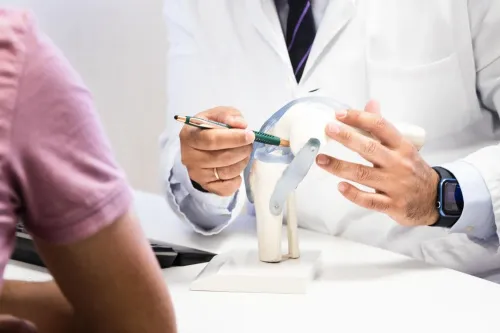
A hip prosthesis is not one fixed product category: surgeons choose the joint surfaces, fixation method, component geometry, and dimensions separately. By the end, you will understand what each choice replaces, the trade-offs between materials and stability designs, and which questions to ask about the implant planned for your anatomy, bone quality, and activity level.
Key takeaways
- Total hip replacement resurfaces both the femoral head and acetabulum.
- Choose bearing materials by weighing wear, noise, activity, and revision concerns.
- Cemented, uncemented, and hybrid fixation suit different bone conditions.
- Ask how implant size and stability features reduce dislocation risk.
Which hip prosthesis design matches the damaged joint?
Total hip replacement replaces both sides of the joint: the damaged femoral head and the worn acetabulum. Hemiarthroplasty replaces only the femoral head, leaving the patient’s acetabulum and its cartilage in place.
| Option | Femoral side | Acetabular side | Typical fit |
|---|---|---|---|
| Total hip replacement | Femoral stem supports an artificial femoral head | Acetabular cup and liner replace the damaged socket surface | Arthritis or disease affecting both joint surfaces |
| Hemiarthroplasty | Femoral stem supports an artificial femoral head | Native acetabulum remains | Many displaced intracapsular fractures in older adults |
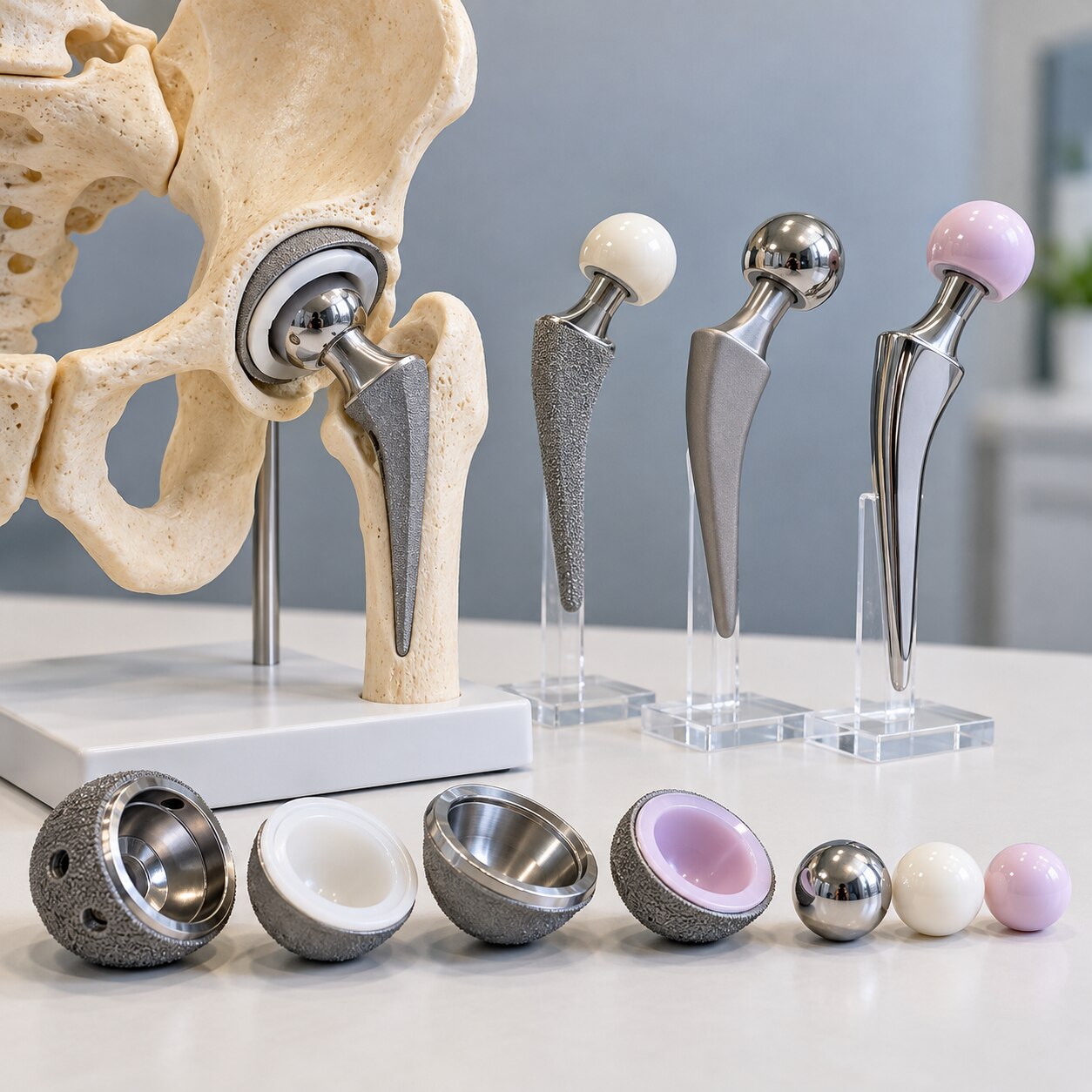
In a total hip replacement, the acetabular cup anchors in the acetabulum, and a liner provides the new bearing surface. The femoral stem fits inside the thighbone, while the femoral head recreates the rounded ball that moves inside the cup.
Hemiarthroplasty can be suitable when the acetabulum remains healthy and the immediate goal is reliable fracture treatment. If the socket already has arthritis, rubbing an artificial head against it can leave persistent groin pain or cause later acetabular wear.
Total hip replacement may offer better function for a selected, independently mobile patient, but it adds an acetabular component and the risks associated with replacing both surfaces. Your diagnosis, socket condition, mobility, and expected activity determine the match.
How do bearing materials affect wear, noise, and revision risk?
Highly cross-linked polyethylene has made ceramic-on-polyethylene and metal-on-polyethylene the common choices. Its lower wear rate reduces debris compared with older polyethylene, but particles can still trigger osteolysis and loosening years later, so revision is not impossible.
| Option | Wear and long-term behavior | Main practical concern |
|---|---|---|
| Ceramic-on-polyethylene | A ceramic head resists scratching and produces little wear against the polyethylene liner. | The liner can still wear; the ceramic head does not remove the risk of osteolysis or loosening. |
| Metal-on-polyethylene | A cobalt-chromium alloy head is tough and reliable, while the polyethylene liner remains the main source of wear debris. | Scratches or taper damage can increase wear, and large heads add sliding distance against the liner. |
| Ceramic-on-ceramic | Both surfaces have extremely low wear and resist scratching. | Squeaking can occur, and component fracture or damage from poor positioning or contamination remains a distinctive risk, although modern ceramic fractures are uncommon. |
| Metal-on-metal hip bearing | The large metal surfaces can release cobalt and chromium particles as they wear. | Metal ions can cause local tissue destruction, pain, implant failure, and systemic exposure; the FDA does not recommend these systems for routine use. |
Ceramic-on-polyethylene avoids ceramic liner fracture while retaining a ceramic head’s scratch resistance. Revision risk depends on more than the bearing: alignment, fixation, implant geometry, activity, and bone response all matter. A proposed bearing deserves discussion in those terms, not as a guarantee of lifelong service.
Should the implant be cemented, uncemented, or hybrid?
A cemented hip stem bonds to bone through bone cement, providing fixation immediately. Uncemented fixation relies on bone growing onto or into a porous implant surface, so it needs suitable bone quality and stable initial seating.
| Option | How it attaches | Factors favouring it |
|---|---|---|
| Cemented | Bone cement fills the gap between implant and bone | Older age, osteoporotic bone, or fracture treatment where reliable immediate stem fixation matters |
| Uncemented | Bone grows into or onto a porous coating | Younger patients with strong bone and expected long-term loading, when the component can obtain firm initial stability |
| Hybrid fixation | Usually a cemented femoral stem with an uncemented acetabular cup | When the femur needs cement support but the socket offers adequate bone for biological ingrowth |
For primary elective total hip replacement, NICE recommends cemented implants and says uncemented implants may be considered in people aged 60 or younger. That recommendation guides discussion rather than replacing assessment of your bone quality, anatomy, prior surgery, fracture pattern, activity demands, and the surgeon’s experience with the design.
After uncemented surgery, early loading follows the surgeon’s instructions because excessive movement before ingrowth can prevent fixation. Cement does not make an implant immune to loosening, and uncemented implants are not automatically longer-lasting. Ask which component is cemented, why that choice fits your fracture or arthritis treatment, and what weight-bearing plan applies.
How do implant size and stability design protect movement and prevent dislocation?
A femoral stem is sized and shaped to fill the patient’s femoral canal without weakening bone or preventing stable fixation. The surgeon sets neck length and femoral offset to restore leg length, muscle tension, and the hip’s centre of rotation. Too little offset slackens abductors; too much increases tissue tension and load.
Head diameter, liner thickness, and cup geometry work together. A larger head increases jump distance—the distance required before the head can lever out—but also increases bearing movement and potential polyethylene wear. The cup’s inclination, anteversion, shell position, and liner rim must provide coverage without causing impingement.
- Standard design: A conventional femoral head and polyethylene liner suit many first total hip replacements when bone, muscles, and spinal mechanics do not create unusual instability risk.
- Large-head design: A larger head makes dislocation harder and may suit active patients or borderline stability, but it is not automatically safer; bearing wear, taper stress, and available liner thickness matter.
- Dual-mobility design: A mobile polyethylene insert moves inside the cup and around the femoral head, adding an extra articulation and greater stability. It is useful for selected revision operations or neuromuscular and spine-related instability risk, but intraprosthetic dislocation remains a distinctive failure mode.
- Constrained design: A locking liner captures the head and is mainly a salvage choice for recurrent dislocation. It transfers higher forces to the bone-implant interface and can loosen, break, or dissociate.
Ask how the chosen stem shape, modular junctions, neck length, femoral offset, head diameter, and cup position fit your anatomy. More adjustment points provide flexibility but add potential sites for corrosion or fracture.
What should you ask before agreeing to a specific prosthesis?
Ask the surgeon to justify the proposed implant against your age, bone condition, anatomy, previous hip surgery, instability risk, activity goals, and their experience with that design—not against a catalogue label.
| Option | Discuss if | Important limitation |
|---|---|---|
| Standard design | First replacement with reliable bone and ordinary stability risk | A larger head improves jump distance but does not correct poor component positioning |
| Dual-mobility cup | Revision surgery, spinal or neuromuscular risk, or high dislocation risk | The mobile insert adds intraprosthetic-dislocation risk when the small head escapes the insert |
| Constrained liner | Recurrent instability requiring salvage | It transfers higher forces to bone and can break, dissociate, or loosen; it is rarely the default for a first replacement |
| Hip resurfacing | Selected younger, active patients with suitable femoral bone and anatomy | It preserves the femoral stem but has femoral-neck fracture and metal-wear considerations |
Ask these questions before consenting:
- Which implant materials form the bearing, and why do they suit my loading, bone quality, and expected lifespan?
- What problem does each modular component solve? Modular heads and necks help adjust length and offset, but add junctions that can corrode or fracture; they cannot rescue poor positioning or weak bone.
- What is my estimated dislocation and revision risk with this design, including after my prior surgery?
- What are the registry or study survivorship figures at 5, 10, and 15 years, and do they match patients my age and activity level?
Published survivorship is an average, not a personal forecast. Ask Dr. Manohar Rao Ortho to explain the absolute revision endpoint, follow-up duration, and failure causes behind any percentage quoted.
Related services
Primary Hip Replacement Restoring Comfortable Movement with Personalized Hip Care **Primary Hip Replacement** is a surgical procedure in which a damaged or severely worn hip... View service → |
Hip Replacement Surgery Regain Mobility. Reduce Pain. Return to an Active Life. View service → |
Frequently asked questions
What is the difference between total hip replacement and hemiarthroplasty?
Total hip replacement replaces the damaged femoral head and acetabulum. Hemiarthroplasty replaces only the femoral head and leaves the acetabulum and its cartilage in place.
How do hip prosthesis bearing materials affect the result?
Bearing materials influence wear, noise, activity considerations, and revision risk. Ask your surgeon which combination suits your age, bone condition, and expected activity level.
Is cemented or uncemented hip fixation better?
Cemented fixation anchors the implant with bone cement, while uncemented fixation relies on bone growth into a textured surface. Hybrid replacement combines the two, so the choice depends on bone quality and implant components.
How do implant size and stability design help prevent dislocation?
The surgeon selects component size, head diameter, neck geometry, and stability features to restore leg length, movement, and soft-tissue tension while reducing dislocation risk.
What should I ask before agreeing to a hip prosthesis?
Ask about the design, bearing materials, fixation method, expected lifespan, dislocation precautions, activity limits, revision plan, and why the proposed implant fits your bone and lifestyle.
Related services
Revision Hip Replacement Specialised Care for Previously Replaced Hip Joints **Revision Hip Replacement** is a specialised orthopaedic procedure performed when an existing... View service → |
Partial Hip Replacement Expert Partial Hip Replacement (Hemiarthroplasty) by Dr. Manohar Rao H R** Dr. View service → |