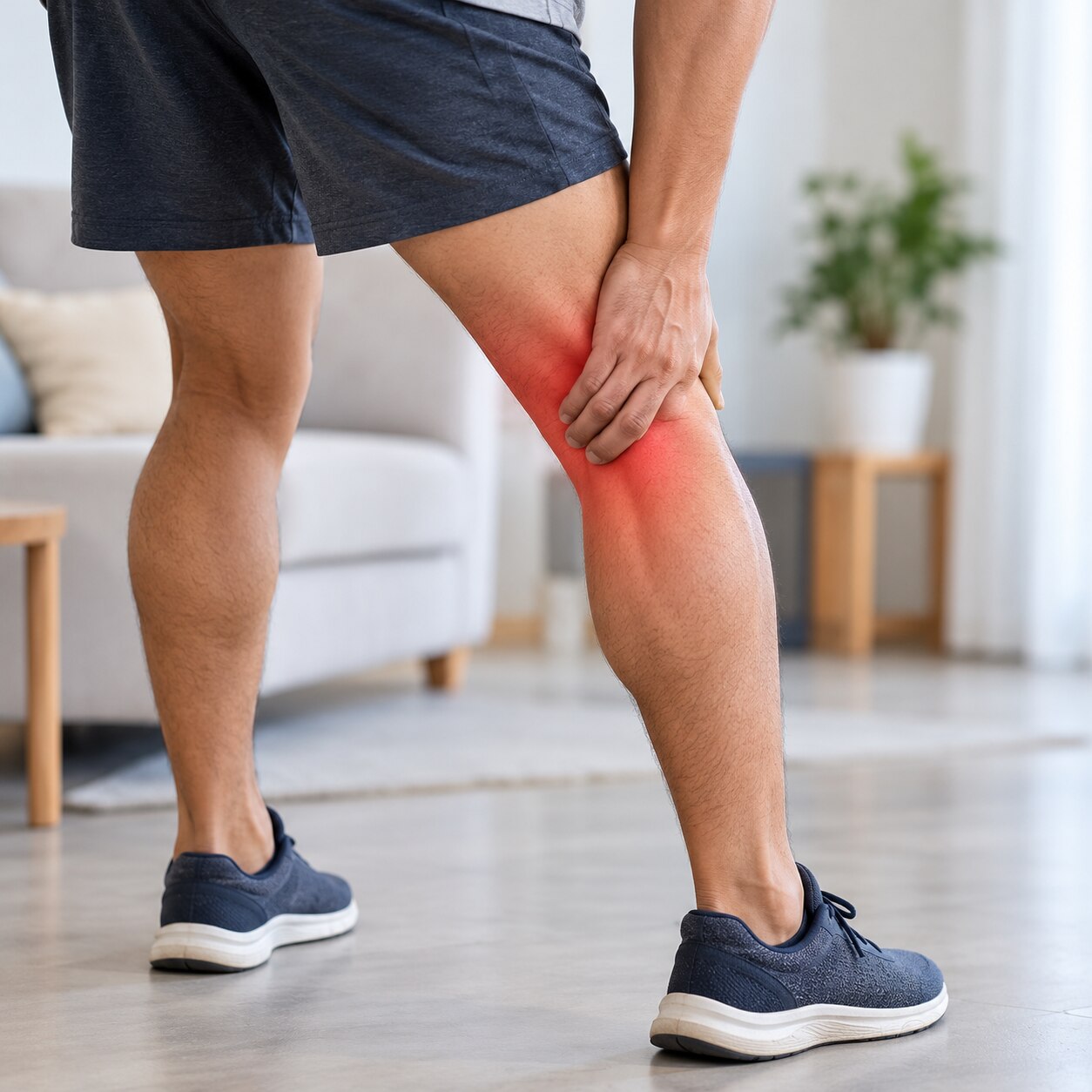
Pain behind the knee can come from the joint, nearby muscles and tendons, nerves, blood vessels, or a problem extending into the calf. By matching the pain’s location and pattern with warning signs, triggers, examination findings, and suitable tests, you can understand which causes need urgent assessment and which treatments are usually considered.
Key takeaways
- Sudden swelling, chest pain, or breathlessness with calf pain requires urgent medical care.
- A Baker’s cyst can cause fullness or tightness in the crease behind the knee.
- MRI, ultrasound, and X-rays answer different questions about knee and calf pain.
- Treatment depends on the cause, from activity changes and medicines to surgery.
What Can Cause Pain in the Crease or Back of the Knee?
Location and pain pattern narrow the possibilities, but they do not confirm a diagnosis. Pain in the crease behind the knee differs from calf pain after exercise, while neurological symptoms require assessment beyond the knee.
| Cause | Location and pain pattern | Associated clues |
|---|---|---|
| Baker’s cyst | Pain in the crease behind the knee; pain when bending the knee as pressure rises | Baker’s cyst symptoms include a soft lump, fullness, or swelling. The cyst often reflects arthritis or a meniscus problem. |
| Osteoarthritis | Posterior aching, stiffness, reduced movement, or pain at rest | Inflammation can cause back-of-knee pain directly or produce a secondary Baker’s cyst. |
| Meniscus tear | Joint-line pain felt toward the back; pain when bending the knee | Catching, locking, swelling, or difficulty straightening the leg supports this cause. |
| Hamstring or upper-calf injury | Pain after running, sprinting, jumping, or sudden overstretching | Local tenderness, bruising, and pain during stretching or resisted contraction favor a muscle-tendon injury. |
| Posterior cruciate ligament injury | Pain after a blow to the front of the shin, a fall onto a bent knee, or forced hyperextension | Instability may become clearer downhill or while going downstairs. |
| Nerve irritation | Burning or electric pain extending below the knee | Tingling, numbness, or weakness can indicate lumbar-spine irritation or another nerve disorder. |
| Deep-vein thrombosis | Calf or back-of-knee pain with sudden one-sided swelling | A warm, red, tender calf needs urgent assessment; do not massage it or assume it is a cyst. |
When Is Back-of-Knee Pain an Emergency?
Get urgent medical assessment for a swollen calf or a warm or red calf, especially when swelling affects one leg or appeared suddenly. Deep-vein thrombosis can cause pain behind or below the knee and can look like a Baker’s cyst or muscle strain.
Call emergency services immediately if possible DVT occurs with:
- Shortness of breath and chest pain, coughing blood, fainting, or a rapid heartbeat
- Sudden severe pain, pain out of proportion to the examination, or rapidly worsening symptoms
- New foot weakness, numbness, or a cold, pale foot
Do not massage a painful or swollen calf or assume it is a cyst. A ruptured Baker’s cyst can send fluid into the calf and cause sudden swelling, but that does not safely exclude a blood clot; ultrasound may be needed for Baker’s cyst versus blood clot.
Get immediate care if you cannot bear weight, the knee looks deformed, or fever accompanies a hot, swollen joint. A pulsating lump behind the knee needs urgent vascular assessment because it can signal a popliteal artery problem. Sudden foot weakness or rapidly worsening numbness should not wait for a routine appointment.
Which Triggers and Examination Findings Help Identify the Cause?
Tell the clinician what happened before the pain started: a recent knee injury, a sudden increase in running or training load, prolonged kneeling or squatting, long-distance travel and immobilisation, prolonged bed rest, recent surgery, or another period of immobilisation. This history helps narrow the causes of pain behind the knee.
The clinician compares both knees, checks range of motion, feels for a lump in the popliteal area, and assesses calf tenderness and swelling. Ligament tests look for instability; meniscus manoeuvres assess joint-line pain, catching, and locking.
| Finding | What it suggests | What is checked |
|---|---|---|
| Localised pain after sprinting, jumping, or overstretching | Muscle-tendon injury | Bruising, tenderness, pain with stretching or resisted contraction |
| Soft popliteal lump | Baker’s cyst | Size, tenderness, and knee movement |
| Joint-line pain with catching or locking | Meniscus injury | Meniscus manoeuvres |
| Burning, tingling, numbness, or weakness below the knee | Nerve or lumbar-spine problem | Sensation, strength, hip, and lumbar spine |
| One-sided calf swelling or warmth | DVT or ruptured cyst | Calf examination and ultrasound when needed |
Arthritis, a previous meniscal injury, inflammatory joint disease, and reduced movement increase the likelihood of a Baker’s cyst. If a blood-vessel or nerve problem is possible, the examination also includes foot pulses and skin temperature. These findings guide testing; pain location alone cannot establish the diagnosis.
Which Tests Match Each Suspected Cause?
The suspected cause determines the test. A weight-bearing knee X-ray for knee arthritis is useful for bone and alignment, while ultrasound for Baker’s cyst or DVT answers a different question.
| Suspected cause | Best-matched test | What it can show |
|---|---|---|
| Osteoarthritis, alignment change, or fracture | Weight-bearing X-ray | Joint-space loss, bone changes, alignment, or a fracture; not a meniscus or most ligament injuries |
| Baker’s cyst or suspected DVT | Ultrasound | A fluid-filled cyst, some soft-tissue problems, or blood-flow changes suggesting a clot |
| Meniscus tear or PCL injury | MRI | Meniscus, posterior cruciate ligament, cartilage, muscle-tendon, and other soft-tissue damage |
| Persistent or unclear soft-tissue pain | MRI | Structural injury when examination findings do not explain continuing symptoms |
| Infection or inflammatory disease | Blood tests for knee pain | Evidence that supports infection or inflammation; these tests are not routine for every case |
A swollen calf needs assessment for a clot, not an ultrasound aimed only at confirming a cyst. A ruptured Baker’s cyst can send fluid into the calf and mimic DVT, so sudden painful swelling should not be self-diagnosed. Blood tests become relevant with fever, an unusually hot joint, or multiple swollen joints.
No scan stands alone. An X-ray may show arthritis while the actual pain comes from a meniscal tear, nerve irritation, or a ruptured cyst. A lump that changes size still needs appropriate imaging when it is painful or appears suddenly.
How Is Pain Behind the Knee Treated?
Treatment follows the cause, not simply the location of the pain. Back of knee pain treatment for a muscle-tendon strain may include temporary activity modification, clinician-directed ice or heat, gradual rehabilitation, and physiotherapy for posterior knee pain.
Use this checklist to match treatment to the diagnosis:
- Osteoarthritis: Combine therapeutic exercise, suitable weight management, activity changes, and pain relief. A topical NSAID may be considered. Oral NSAIDs require review of stomach, kidney, liver, heart, blood-pressure, pregnancy, and medicine-interaction risks. Check NSAID safety with a clinician or pharmacist before taking an anti-inflammatory drug.
- Baker’s cyst: Treat the arthritis, meniscal tear, or other knee problem producing excess fluid. Baker’s cyst aspiration or injection with corticosteroid can relieve symptoms in selected patients, but the cyst can recur.
- Muscle or tendon injury: Progress from temporary load reduction to strengthening and movement-based rehabilitation rather than returning immediately to running or jumping.
- Confirmed deep-vein thrombosis: Follow clinician-directed anticoagulation. Do not use massage or exercise treatment for a suspected or confirmed clot.
- Structural injury: Consider surgery only for selected traumatic injuries, persistent mechanical locking, or instability that remains after appropriate conservative care. Arthroscopy is not a general treatment for uncomplicated osteoarthritis.
Dr. Manohar Rao Ortho can help match persistent posterior knee pain or walking limitation with examination findings and imaging, so treatment targets the actual pain generator rather than an incidental cyst or X-ray finding.
Related services
Back Pain Management Our Back Pain Management program is designed to diagnose, treat, and relieve acute and chronic back pain with a comprehensive, patient-focused... View service → |
Arthritis Treatment focuses on relieving joint pain, reducing inflammation, and improving mobility for patients affected by degenerative or inflammatory joint... View service → |
Frequently asked questions
What can cause pain in the crease or back of the knee?
Possible causes include a Baker’s cyst, hamstring or calf strain, meniscus injury, ligament damage, arthritis, tendon problems, nerve irritation, and a blood clot.
When is back-of-knee pain an emergency?
Seek urgent care for a swollen, warm, red calf; sudden severe pain; chest pain; breathlessness; fainting; a cold or pale foot; or inability to bear weight after an injury.
Which tests help identify the cause of pain behind the knee?
X-rays assess bones and arthritis, ultrasound can assess a Baker’s cyst or blood flow, and MRI evaluates menisci, ligaments, cartilage, tendons, and other soft tissues.
How is pain behind the knee treated?
Treatment depends on the diagnosis and can include activity modification, ice, prescribed medicines, physiotherapy, treatment of an underlying condition, injections, or surgery.
Related services
Back Pain Treatment Comprehensive Back Pain & Spine Care Back pain shouldn’t dictate how you live, work, or move. View service → |
Arthritis Arthritis causes joint inflammation, leading to stiffness, swelling, and restricted mobility. |
Knee Arthroscopy Knee Arthroscopy is a minimally invasive surgical procedure that allows Dr. View service → |
Sports Injury Treatment Sports injuries can significantly hinder an active lifestyle. At our center, Dr. View service → |